World War 2: True Stories of German UBoats & Their Dangerous Missions (Submarine, WW2, WWII, Soldier Stories Book 1) by Leonard Cooper
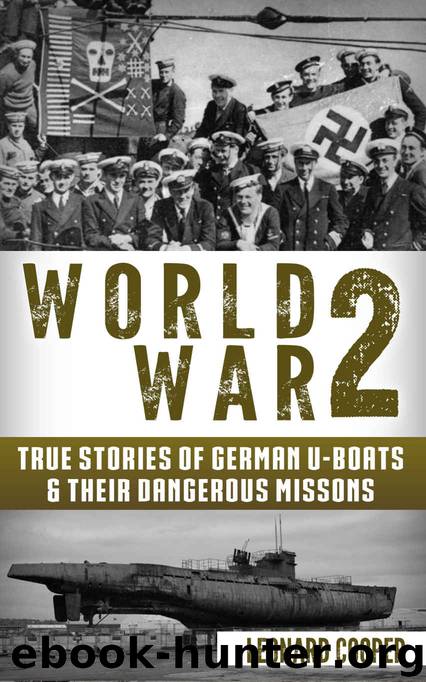
Author:Leonard Cooper
Language: eng
Format: mobi
Publisher: First Class Publishing
Published: 2016-04-03T21:00:00+00:00
The Americans made it much easier for the U-boats than it needed to be. Despite the urging of the British, which had been going on for some time, even before the official entry of the US into the war, the Americans refused to place their ships into convoys. Many ships operating in US coastal waters were on their own, with virtually no naval escort to speak of. Some merchantmen were equipped with 3 or 5-inch guns, but many were not, and the ones that were found them to be largely ineffective. Traveling at perhaps three to five knots, they were sitting ducks for both surfaced and submerged U-boats.
It did not help that the United States did not enforce black-out measures until the war had been going on for some time. Under black-out restrictions, all but the most necessary lights would either be turned off, or covered/dimmed. Cars' headlights would be painted with black paint with tiny slits allowing a bare minimum of light to shine through. Street lights? Off. But all of these things did not occur until the losses had already reached astronomical proportion. In many ways, the American federal and local governments' lack of blackout enforcement was criminally negligent and many died because of it.
Looking at the picture above, you can see how easy it would be to spot surface vessels against the lights of the coast, and it was not just in New York where the lights continued to burn. The whole East Coast was lit up like a Christmas tree for much of 1942. Many vessels were sunk away from the main crossing points at New York and Boston. Tankers in the Gulf of Mexico, and other vessels, especially off Georgia and the Carolinas were sunk with ease.
The first operation against the Americans in US waters was called “Paukenschlag” (“Drumbeat”), and U-66 by this time a veteran boat and crew,did its part. Leaving the French port of Lorient in December, U-66 and Käpitan Zapp arrived off the US coast in January. On 18 January 1942 the tanker SS Allan Jackson was sunk by Zapp and his crew.
The next day off Cape Hatteras, Zapp sunk the RMS Lady Hawkins, a Canadian ocean liner carrying cargo as well as 213 passengers, fifty of whom were servicemen, the rest civilians from Canada, the West Indies and the USA, and 107 crew. She was following a zig-zag course to help avoid torpedoes, but was hit with two stern fired tubes from U-66 and sank in thirty minutes. The majority of those on board perished either on board or at sea.
On January 22 the tanker SS Olympic out of Panama was sunk. All thirty-five of her crew went down with the ship. Two days later, the British tanker Empire Gem was hit by U-66. Her bow went down immediately, but her stern remained afloat for some time, just long enough for a US Coast Guard vessel to rescue the only two seamen that survived. Later that same day, U-66 sank the American cargo vessel SS Venore was sunk.
Download
This site does not store any files on its server. We only index and link to content provided by other sites. Please contact the content providers to delete copyright contents if any and email us, we'll remove relevant links or contents immediately.
| Africa | Americas |
| Arctic & Antarctica | Asia |
| Australia & Oceania | Europe |
| Middle East | Russia |
| United States | World |
| Ancient Civilizations | Military |
| Historical Study & Educational Resources |
The Radium Girls by Kate Moore(12112)
100 Deadly Skills by Clint Emerson(4983)
Rise and Kill First by Ronen Bergman(4857)
The Templars by Dan Jones(4750)
The Doomsday Machine by Daniel Ellsberg(4576)
The Rape of Nanking by Iris Chang(4276)
Killing England by Bill O'Reilly(4064)
Stalin by Stephen Kotkin(4023)
Hitler in Los Angeles by Steven J. Ross(3993)
12 Strong by Doug Stanton(3590)
Hitler's Monsters by Eric Kurlander(3411)
The Code Book by Simon Singh(3269)
Blood and Sand by Alex Von Tunzelmann(3255)
Darkest Hour by Anthony McCarten(3184)
The Art of War Visualized by Jessica Hagy(3057)
Hitler's Flying Saucers: A Guide to German Flying Discs of the Second World War by Stevens Henry(2785)
Babylon's Ark by Lawrence Anthony(2744)
Tobruk by Peter Fitzsimons(2575)
The Second World Wars by Victor Davis Hanson(2559)
